Thursday, May 12, 2016

Final Thoughts

What did you learn from this class and what future interest and how do you imagine planning and using Technology in your future classroom?

I learned through this class that there are many aspects of digital technology that can be added into a classroom setting; however, it appears that technology and art have long been linked, and in today's digital age the fields are still struggling to find a balance. For example, graphic design is art, but does art class include graphic design? Should photography principles be taught using film or digital camera equipment? The list goes on.

Discovering how to incorporate educational tactics like the SAMR model in my future classroom will be of particular interest to me, since the adjustments were easy to employ for a single example lesson. Also, if 3-D printing continues to remain fairly affordable I think it would offer students a fun opportunity to build something from a digital drawing. The 3-D scanning we did as a class seems even more approachable for students who may have a harder time rendering using three-dimensional software... I know I do.

via GIPHY

Saturday, May 7, 2016

Personal Learning Network

The Mobile Phone Camera in Educational Settings


Goal Statement
With my online personal learning network, I am seeking to educate myself about the evolution of the mobile phone camera and its current use in educational settings. The quality of mobile phone cameras has only continued to progress, and I want to try and possibly relate its progression to past/present/future educational usage.

Resource Networks

Websites and Apps:
Edutopia

DigitalTrends.com

Tech Crunch

YouTube

Juxtaposer


People:
Colin Young, Chicago-based app developer

Moneythink, financial literacy education group

Team Polymathic, software consulting firm


Books and Articles:

Software/Services: 

  • Smartphones! (iPhone most specifically) 
  • Developer Dinner (a free service where developers meet over dinner at Polymathic)


Summary of Outcomes:
      My online resources helped familiarize me with the history of mobile camera phones. According to the fantastic “timeline” on http://www.digitaltrends.com/mobile/camera-phone-history/, the first mobile phone with a built-in camera was made by Samsung and released in South Korea in 2000… Only sixteen years ago. This camera was essentially an entirely separate attachment on a mobile phone. I found it interesting that it was not until November 2002 that the United States integrated digital cameras into a $400 Sprint phone, called the Sanyo SCP-5300; it then took less than a year for camera phones to rival DVD player sales. My history lesson continued with the 2014 journal article “Photo Filter Apps: Understanding Analogue Nostalgia in the New Media Ecology” by Elena Caoduro, in which it was mentioned that by “July 2013, however, sales of digital cameras in the United States of America started to fall both in terms of revenue and in unit shipments, as more consumers turn to smartphones with high-resolution cameras to take snapshots and share them instantly through social media.”
      This concept of social media and its inherent relationship with the mobile camera phone was enhanced by my findings in The Camera Phone Book, which introduced me to the concept of “Moblogs.” Much like photo blogs, a moblog is a weblog whose content purely originates from mobile phones and other portable wireless devices. While its popularity peaked around 2007, the tool continues on with websites such as www.moblog.net. An article published around this same year by Thomas Cochrane, entitled “Mobile Blogging: A Guide for Educators,” stated that, “A mobile (m-learning) pedagogical model will focus upon enhancing communication, collaboration, and will be student-centred.” I believe the possibilities for “m-learning” has only continued to advance in the almost decade that has followed.
      One such outcome of connected learning using mobile and camera-enabled technology includes “Moneythink Mobile.” One of the company’s most useful developments has been this social media app, which is a kind of “gamified Instagram” that offers students incentives to practice money management skills; they earn points and social affirmation in the form of “likes” and comments on pictures uploaded to the app of items they either saved money on or are saving for. Opportunities for instantaneous teachable moments like this would not have been possible without camera-enabled, wireless smartphones.

My PLN Future:
      When I began the process of creating my PLN, I was inspired by my personal inclination for the art of visual storytelling. My educational background is in theater and art history, two fields that require an understanding of synthesizing and sharing information in interesting yet informative ways. Additionally, my personal history as the daughter of a professional photographer, whose work has transitioned from film to digital, further heightens this interest in visual storytelling. I asked questions starting out that included, “What are we losing in this transition of technology, and what are we gaining?” and “How has the photography industry changed as well, in sales and in technological advances to compete with portable phone cameras?”
      This first question of loss and gain was not answered entirely through my research, but is aiding in my thesis exploration on the link between photography and nostalgia. I believe my working on my PLN will help me transition into next year’s thesis fieldwork, specifically thinking of having students engage in a kind of “moblog” that is specific to our classroom. This mobile camera-specific blog site is interesting to me because it’s kind of “pure,” like a photo album, rather than how images are used on social media sites to specifically gain “likes,” comments, and followers. However, I will have to think of how technology will work in the CPS classroom setting, as I understand they do not have a “BYOD” policy where students can use their own smartphones and devices in school. Furthermore, Elena Caoduro’s article, “Photo Filter Apps: Understanding Analogue Nostalgia in the New Media Ecology,” has been highly influential in my thoughts regarding smartphone camera aesthetics, and has led me to question how to bring nostalgic analogue photographic practices into photography classes for high school students. Do we need “filters” on digital cameras, as Caoduro mentions apps like Instagram are based on, or can the images speak for themselves through content and framing alone?
      As a future teacher, I will work to find ways to utilize smartphone and digital gadget cameras into curriculum because this technology is essential— so, let’s use it, not ignore it! Beyond the obvious social media sites that allow for and encourage the uploading of pictures taken on a user’s smartphone, I’m intrigued by apps such as Volley, which scan a document and “highlight” key information. If we turn what an app deems “important” on its head, how would that look in an art classroom? I also really enjoy photography apps, such as “Juxtaposer,” which allows for the layering and experimentation of altering digital photographs directly on a smartphone. It brings a bit of the handcrafted appeal back to photo editing because one’s finger is used to make all edits on the phone’s touchscreen.
      Ultimately, I see the benefit of personal learning networks being a kind of touchstone for projects and self-development. It’s nice to see my resources mapped out in one location, and I look forward to growing this PLN in the months (and even years) to follow!

Monday, April 25, 2016

3D Printing + Upcycling = Genius


3D printing is fascinating to me. Though I've never been very good at designing in three dimensions, (let alone creating the models on a computer program like Google SketchUp that gives me vertigo when I spin the "world" around) I find it awesome and inspiring that others can look at a digital plane and "build" upon it with success and accuracy.

However, I do understand the idea of upcycling, which is the reuse of discarded objects in such a way that it creates a product of a higher quality or value than the original. The above example is a doll's house made of old clear CD jewel cases connected by pink 3D-printed clips. Simple and brilliant! The website Thingiverse.com has an entire section devoted to upcycling options, from printed "mug handles" for glass jars to a support box that converts leftover plastic microwavable food containers into a stackable drawer system.

In today's consumer culture, I think the option to create sustainable upcycled objects using 3D printing is an awesome way forward. Especially since old filament can be remelted for future use!

Thursday, April 21, 2016

On Repeat

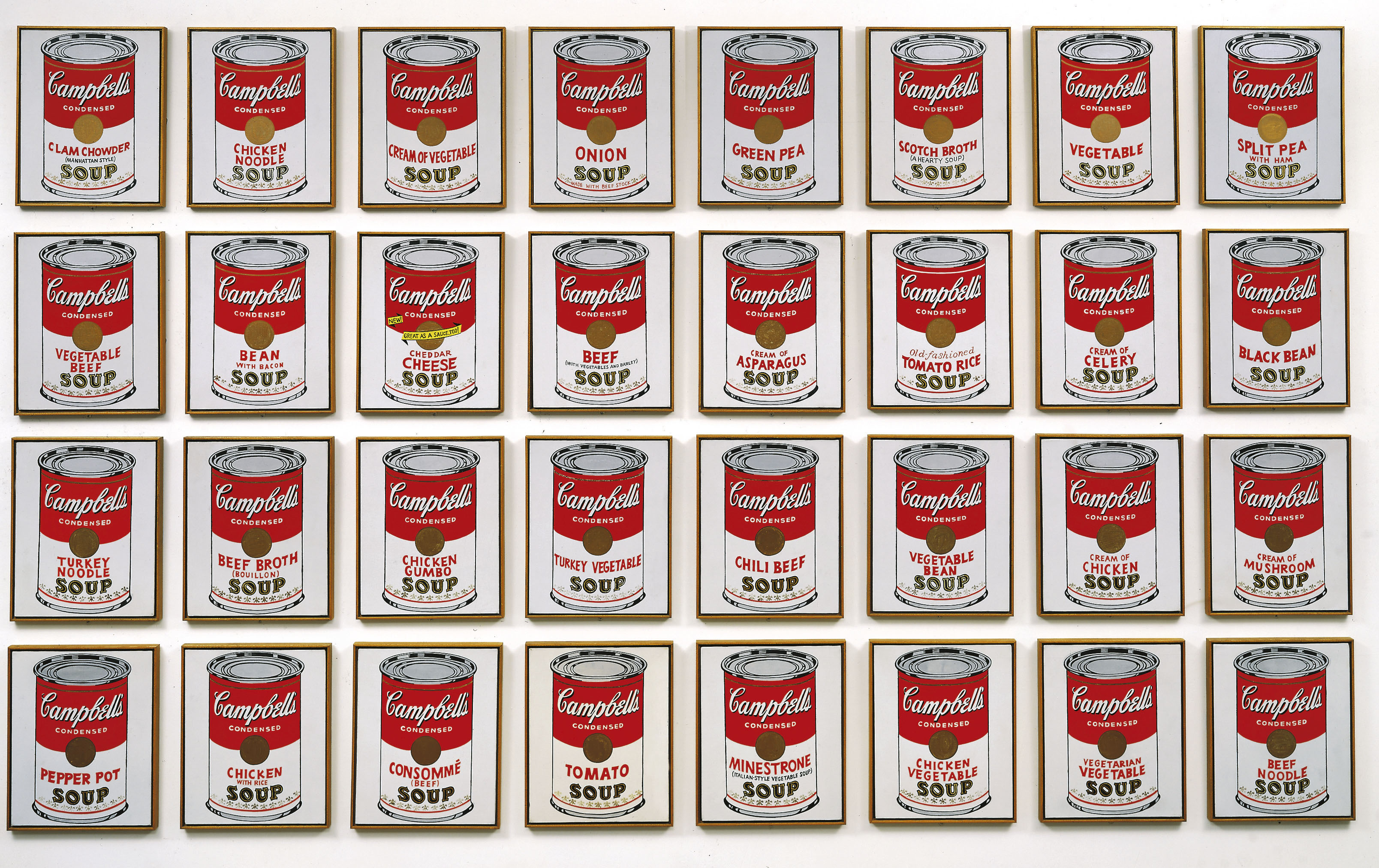
“My fascination with letting images repeat and repeat - or in film's case 'run on' - manifests my belief that we spend much of our lives seeing without observing.” – Andy Warhol


Andy Warhol was the king of repetitive art. His pop art paintings created during the 1960’s depicted everything from celebrities, ordinary objects, and even uncomfortable scenes of death. That, as his quote claims, Warhol believed we “see” things throughout life without observing, or understanding, can relate to today’s culture of omnipresent media.

Think about it: ads for the same products are everywhere, and digital screens display any image at any time provided by search engines connected to every website in the world. We are living in a period of time that not only provides this kind of repetitive communication… we the consumers are asking for it. Particularly, social media provides an outlet for this need to observe repetitive representation, which allows for photo albums upon photo albums representing the self.

Yet, this kind of image indulgence is not something I view as overtly negative. Unlike the points presented by Walter Benjamin in The Work of Art in the Age of MechanicalReproduction, it appears that throughout history humans have craved repetition; technology has risen and advanced to fulfill this need. Photography, for example, shortened the amount of time necessary for artists to capture a particular moment. Even so, photography as a medium has even outpaced itself during the transition from purely analogue film photography to digital… The examples go on, but the central need noted by Warhol to truly observe life through repetition is a natural progression of image (and art) understanding. Through repetition comes more opportunity to critique and try to get to “know” just what it is we are seeing.

Thursday, April 14, 2016

3D Printing, Wedding-Style

I have 3D printing to thank for my engagement ring.

My fiancé and I have been very fortunate that our families gifted us rings; one from his grandma was "planned" and used by my fiancé to pop the question, so to speak. The second ring was a surprise gift from my grandmother upon hearing we would be redesigning the original ring, who wanted to offer us a piece to include in the final design. Suffice it to say, this piece of jewelry has had a rather emotional and significant meaning from the start.

Our jeweler allowed us to design a ring from scratch... but because I know nothing about ring design I chose to revamp a model they had in the store already. The experience began with the jeweler creating a three-dimensional CAD (computer-aided design) drawing of the new ring with computer software. The design was approved and eventually brought to life through - of course - a 3D printer! This piece was printed to confirm the style was correct, the size was roughly right, and also, I assume, to pump up my excitement that the new ring was almost ready.

Unfortunately, I wasn't able to keep the 3D-printed ring because it served a very functional purpose beyond hyping me up: it was melted during casting. Much like the centuries old technique of lost-wax casting, my plastic ring gave way to a golden version. I'm so grateful for the experience of designing my ring, in which technology played a huge part.


Tuesday, April 5, 2016

Do we know about progressive education? Yeah, DEWEY!


Taliesen West was one of the last great buildings that Frank Lloyd Wright personally had a hand in constructing. Created as an architecture school and living quarters in the desert of Arizona, Wright was the sole teacher for all adult students on campus. He believed his students would have the most valuable experience by "doing" architecture, so together they designed and the students built this gorgeous structure.

My tour guide when I visited Taliesen West last month (pictured left in the sunglasses) was a retired Chicago-area school teacher. He explained Wright was simply following the educational theory put forward by education pioneer, John Dewey. Dewey's concept of experiential learning meant that students were actively participating in what they were learning; the teacher is also participating, but takes a back seat so students are allowed in the "driver's seat," so to speak.

My tour guide lamented, however, that many pre-service teachers he met before his retirement had never heard of Dewey's groundbreaking theory. I was proud to tell him SAIC heavily emphasizes Dewey's theories and he complimented our program for doing so.

How, then, does my experience at Taliesen West relate to Grant Lichtman's TedTalk, "What 60 Schools Can Tell Us About Teaching 21st Century Skills"? After visiting (like the title of his talk suggests) roughly sixty schools across America Lichtman asked himself the question, "Where do we want to be as educators? What does great education look like?" His answer: DEWEY. Though Dewey's philosophy is over a century old, many modern educators remain stuck in the stifling industrial age model. Lichtman advocates for "preparing students for their future, not our own past." To me, this relates to teaching evolving technologies to the best of any school's ability, but with a heavier focus on the openness and overall adaptability of teachers in all subjects. From art to architecture to math and science, students deserve teachers that let them "do" as Dewey recommends.

Sunday, March 13, 2016

Rhapsody in Blue... white, yellow, red, & black


I realize the song “Rhapsody in Blue” is a little jazzier than boogie-woogie style tunes. Nevertheless, George Gershwin’s masterpiece immediately came to mind when I envisioned Piet Mondrian’s painting Broadway Boogie-Woogie, which I've seen hanging in the MoMA; the song’s order and rhythm for me speaks to the De Stijl art movement, which features paintings with white backgrounds, black grids, and an alternating pattern of the three primary colors. Broadway Boogie-Woogie differs from Mondrian’s usual style in that it is based on realism: the vibrant city streets of New York and their own special grid-like organization. That inspired me to try and bring in some sounds of Broadway music, mingled with the ubiquitous sounds of traffic and crowd chatter. Yet, I chose to have the piece end with a melodic, orderly portion of “Rhapsody in Blue” because I believe the painting is about finding harmony among the chaos.

Projects like this allow for a different creative outlet, and can speak to art historical sensibilities, which I enjoy. The software requires some patience, though, so I wonder what age set a project like this might be best for. Maybe middle school and up?

Tuesday, March 8, 2016

Internet Podcasts Set Storytelling Stage

While not a regular podcast fan, I am the daughter of an avid National Public Radio-listening mother. I'm so thankful for this upbringing because I believe it has led to my own interest in talk radio, and subsequently, podcast storytelling. Much of my childhood featured a soft-spoken talk radio soundtrack provided by WBEZ, or the not-so-dulcet tones of The McLaughlin Group's political thoughts on PBS...            ["Bye Bye!"]


In a culture where video media reigns supreme, audio podcasts have cemented their value. One podcast episode of NPR's This American Life has left a particularly indelible mark on me. This episode, "Mr. Daisey and the Apple Factory," aired in 2012. A show known for its truthful ruminations on-- you guessed it-- aspects of American life, T.A.L. audiences were shaken by Mike Daisey's tale of visiting the Shenzhen factory in China where Apple products are manufactured and the unimaginable horrors he encountered of the workers' living/working conditions.

What T.A.L. either failed to realize or flat-out ignored when they greenlit this episode is that Daisey is a monologist, a performer. Almost immediately after the episode aired, NPR retracted and removed the episode due to multiple "fabrications." Yes, there were fabrications because Daisey is a storyteller who utilized his access to one of the nation's top audio platforms and shared a tragic warning of what could be in our fast-paced, techno-driven future when we ignore "hand-made" objects and the hands that construct pieces of our lives. However, I wonder if it was really appropriate for Daisey to share this story without revealing to NPR that its contents were not entirely truthful? (Or is that the whole story? Did NPR possible know ahead of time and merely responded to audience backlash? The world may never know.)

I had the honor and privilege to see Daisey perform this piece in Washington, DC, and his story is even more visceral in person, due in no small part to his larger-than-life persona and the weight of his tale. That the spoken word remains so powerful via podcasts in the 21st century is truly exciting, and I look forward to discovering what stories unfold next. Let us consider how podcasts can be used not only as a nonfiction outlet, but also as a storytelling medium.


Sunday, March 6, 2016

Stop Motion Animation: "The Fall"


This stop motion animation conveys the visual art concept of movement through the act of falling with a single magazine cut-out. Enjoy!


Tuesday, March 1, 2016

Stop (Motion Animation) In the Name Of Love

Why do I advocate for educational stop motion animation projects? Because I myself made one in high school:


Granted, the animation speed is about twice as fast as it needs to be in comparison to the transition slides, but I remain proud of this work that combined my then-strong fascination with lawn gnomes with an ongoing love of Parisian culture into a cute little video.

I recently took a college-level course in digital animation, during which I discovered that the 18 and up set still loves making stop motion animation. While some classmates pushed toys and other easily manipulated objects in front of the camera lens, my project features more cut-paper animation:


Why, then, do students of all ages get so much out of this art form? I believe it speaks to our intrinsic human desire for storytelling. Art is filled with stories, but sometimes the chosen media can hinder more than help "performances." Students who are young and old, familiar with tech or not can easily grasp the mechanics needed to make an object move across the screen. All it takes is a little push from the student's hand to move the object, and another push to click the button of the camera to capture a still frame. Move the object enough times and push the button enough, then process in a computer program and you’ve got yourself a movie!

Stop motion animation is a democratic medium, one that – thanks to the magic of photography – ensures what students place in front of the lens will reappear onscreen. It doesn't require the skill sets associated with other art forms, such as drawing or sculpture creation, which students who don’t consider themselves “artists” and/or lack confidence in these areas might worry will result in work that differs from what they “see” in their mind’s eye. I believe that, much like the theater arts I mentioned in my last post, stop motion animation is an ideal art medium to incorporate into new STEAM classroom curriculum because it's a prime example of creative project-based learning.

Tuesday, February 23, 2016

Theater Arts for the Win


It’s both terrifying and exciting to be studying as a pre-service arts education teacher for the state of Illinois. Since I am studying (and hope to one day work) in Chicago, news of the CPS layoffs and potential arts cuts concerns me on a daily basis…

Nevertheless, one method that could ensure arts’ inclusion in the classroom is to create more “project-based” learning opportunities. Edutopia breaks down project-based learning as a combination of:
  • Designing and/or creating a tangible product, performance or event
  • Solving a real-world problem (may be simulated or fully authentic)
  • Investigating a topic or issue to develop an answer to an open-ended question
This description compliments the America Society for Engineering Education’s recent study identified several characteristics of quality STEM programs:

1. The context is motivating, engaging, and real-world.
2. Students integrate and apply meaningful and important mathematics and science content.
3. Teaching methods are inquiry-based and student-centered.
4. Students engage in solving engineering challenges using an engineering design process.
5. Teamwork and communications are a major focus. Throughout the program, students have the freedom to think critically, creatively, and innovatively, as well as opportunities to fail and try again in safe environments.

If American education is truly concerned about creating real-world, participatory, and collaborative group projects, I truly believe incorporating more theater into the curriculum would help solve the issues of educational inclusivity combined with independent thinking. An inherently collaborative art, theater incorporates technology, memorization, communication skills, and personal responsibility into every single production. Even an article published yesterday heralds the ways that theater arts can turn abstract subjects like math into more concrete, understandable and measurable topics for students of all ages -- which suggests great things for the future of transdisciplinary arts education.

If students are learning to adapt to the changing demands of the workplace, arts educators should also work to ensure art's place in national curriculum.

Wednesday, February 17, 2016

Full STEAM ahead!


The article “Kids Unite Art and Science and Create a World of Wonder” brings up a fantastic, often overlooked point that many of those who have contributed the most to “scientific” endeavors are skilled artists, as well. And really, why should this come as a surprise? Creativity simply means one has the freedom to think abstractly, boldly imagine, and act on ideas. That sounds like the description we’ve grown up with when learning about stereotypical scientists and artists, alike!


When did the subjects of art and science become separated and placed in vacuums, anyway? As this article points out, they were “once inextricably linked, both dedicated to finding truth and beauty”! It’s this kind of so-called “distinction” between subjects that prevents creativity from flowing interdisciplinarily. Personally, projects like “Global Cardboard Challenge” sound like ideal settings for growth and understanding, wherein - as “Kids Unite…” explains - students created bowling lanes relative to their smaller size and that of the classroom. Yet, it’s harder to “quantify,” “assess,” and “standardize” the learning that takes place experientially, so without STEAM as a framework for American education to embrace, lessons like these will remain few and far between.

I think STEAM has been mostly promoted through the avenue of  technology. Titles like “developer” or “maker” invite students to “create” in the supposedly non-artistic field of science. Really, these are just 21st Century terms for an age-old title: inventor. Successful schools that have integrated STEAM structures into their curriculum, and treat students like inventors/investigators, are held up as special beacons, which can be emulated but are harder to replicate. Ideally it seems STEAM should just become part of the everyday curriculum, yet bringing imagination to life through the arts and sciences still requires special student titles, global student “Challenges,” and
awestruck wonder when considering how unique it would be to truly integrate art into education. This leaves me to wonder, what does the nation think “art education” means?

Tuesday, February 9, 2016

Messing About with Computers: Making Transdisciplinary Learning Personal

What an individual can learn, and how he learns it, depends on what models he has available.” – Seymour Papert

I still fondly remember receiving rolly-polly bugs as pets in an elementary science class, even though I can’t recall why we were examining them in the first place. I also remember creating home movies in middle school (on film!) about tectonic plate shifts. But, by the time I reached high school, the subject I had actually enjoyed transformed into segmented periods to which I could no longer relate. While biology was still a point of interest, I really struggled to comprehend chemistry and physics. Since these memories clearly remain pretty fresh and negative, reading about Seymour Papert’s goal to make scientific inquiry personal read like a breath of positive, fresh air.

That his inspiring article, “Computer as Material: Messing About with Time,” was written in 1988, however, proves disconcerting. In the reading, he describes a series of sessions where junior high students with different interests and skill strengths came together to experiment with programming clocks. While some naturally took to the computer programming language, LOGO, he brought into the classroom, others built the ramps where motorized cars would run on, or contributed ideas as to how to make the clocks’ timing more efficient. In essence, it seems like the ideal setting for discovery and performing learned math/science terms (such as variables) in a practical, tangible way.  Furthermore, the assignment required a multitude of talents to achieve the group’s collective goal.

Would more classes in other disciplines prove this fruitful if students were allowed to experiment freely? I believe so, and this hypothesis is in part supported by MIT’s Scratch software. The LOGO programming language was expanded into Scratch by Seymour Papert’s student Mitchel Resnick, and having just put it to use myself by animating my name, I can say that it turns programming into a fairly painless act. (As evidenced by my animation, I am by no means an expert.) That this application is located on a website even allows people of all ages around the world to create animated 2-D stories, and I think if this were around when I was a kid it would have been something I could relate to as a more language arts-minded student.  

Compare Scratch technology with Papert’s explanation of how computers were used in the late 20th century:
“An examination of computer use in schools today reveals that students' interactions with computers are largely teacher-directed, workbook-oriented, for limited periods of time, and confined to learning about the machines themselves or about programming languages. Further, computers are located in separate labs and are not integrated into the standard curriculum. ‘Doing computer’ in school is thought of as an exciting activity in and of itself.”

We’ve come a long way from the clunky desktop computers Papert describes from the 1980s, with laptops, tablets, mobile technology, and last but not least, the INTERNET making devices and the activities performed on them more transportable and user-friendly. Yet, aren’t computers still often treated as a separate, slightly scary, and serious entity that must be “done” and utilized? Do you feel the use of technology remains teacher-directed and scientific? How can we still improve school computer usage to help coursework become more transdisciplinary, as Scratch aims to achieve?