Monday, April 25, 2016

3D Printing + Upcycling = Genius


3D printing is fascinating to me. Though I've never been very good at designing in three dimensions, (let alone creating the models on a computer program like Google SketchUp that gives me vertigo when I spin the "world" around) I find it awesome and inspiring that others can look at a digital plane and "build" upon it with success and accuracy.

However, I do understand the idea of upcycling, which is the reuse of discarded objects in such a way that it creates a product of a higher quality or value than the original. The above example is a doll's house made of old clear CD jewel cases connected by pink 3D-printed clips. Simple and brilliant! The website Thingiverse.com has an entire section devoted to upcycling options, from printed "mug handles" for glass jars to a support box that converts leftover plastic microwavable food containers into a stackable drawer system.

In today's consumer culture, I think the option to create sustainable upcycled objects using 3D printing is an awesome way forward. Especially since old filament can be remelted for future use!

Thursday, April 21, 2016

On Repeat

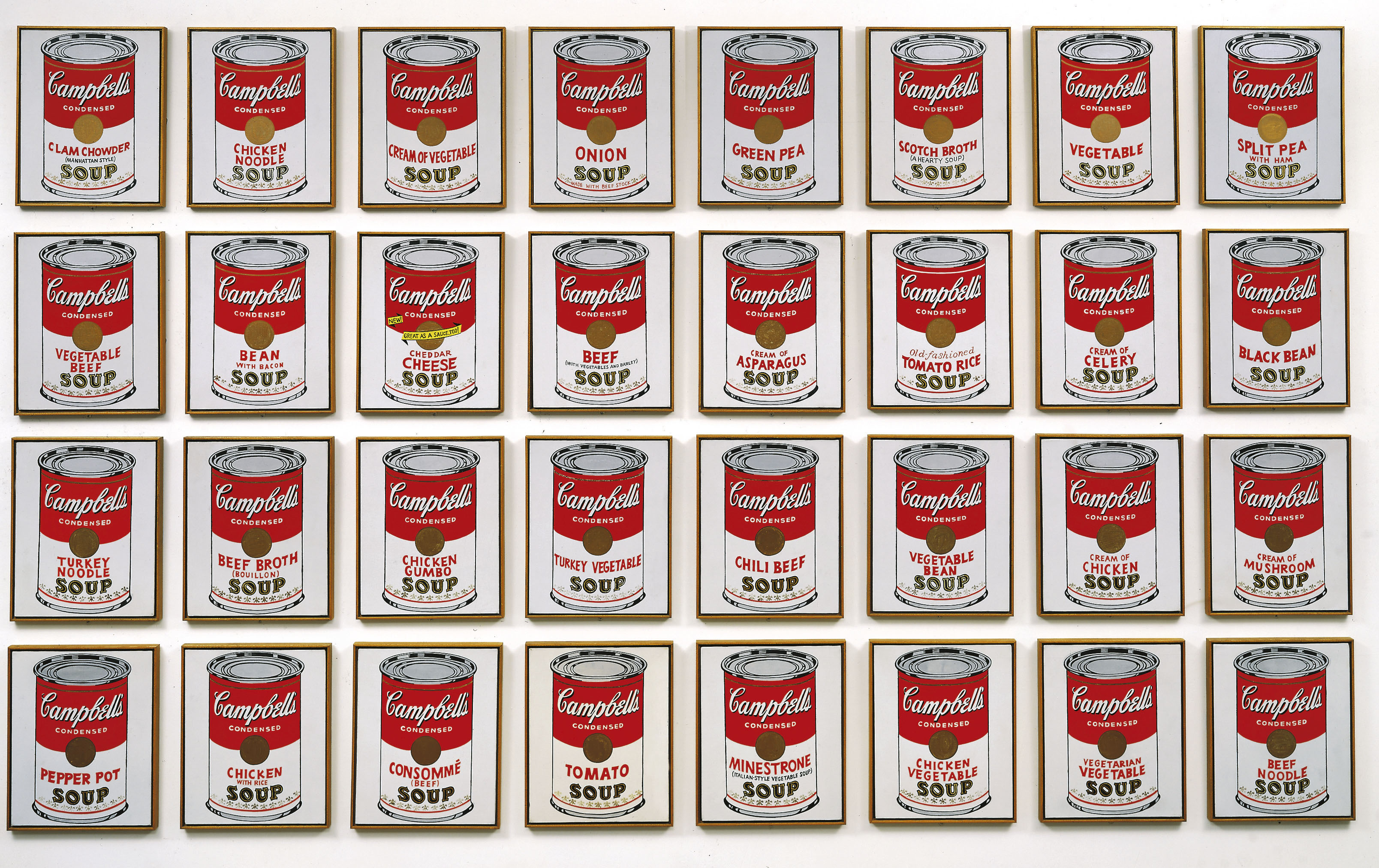
“My fascination with letting images repeat and repeat - or in film's case 'run on' - manifests my belief that we spend much of our lives seeing without observing.” – Andy Warhol


Andy Warhol was the king of repetitive art. His pop art paintings created during the 1960’s depicted everything from celebrities, ordinary objects, and even uncomfortable scenes of death. That, as his quote claims, Warhol believed we “see” things throughout life without observing, or understanding, can relate to today’s culture of omnipresent media.

Think about it: ads for the same products are everywhere, and digital screens display any image at any time provided by search engines connected to every website in the world. We are living in a period of time that not only provides this kind of repetitive communication… we the consumers are asking for it. Particularly, social media provides an outlet for this need to observe repetitive representation, which allows for photo albums upon photo albums representing the self.

Yet, this kind of image indulgence is not something I view as overtly negative. Unlike the points presented by Walter Benjamin in The Work of Art in the Age of MechanicalReproduction, it appears that throughout history humans have craved repetition; technology has risen and advanced to fulfill this need. Photography, for example, shortened the amount of time necessary for artists to capture a particular moment. Even so, photography as a medium has even outpaced itself during the transition from purely analogue film photography to digital… The examples go on, but the central need noted by Warhol to truly observe life through repetition is a natural progression of image (and art) understanding. Through repetition comes more opportunity to critique and try to get to “know” just what it is we are seeing.

Thursday, April 14, 2016

3D Printing, Wedding-Style

I have 3D printing to thank for my engagement ring.

My fiancé and I have been very fortunate that our families gifted us rings; one from his grandma was "planned" and used by my fiancé to pop the question, so to speak. The second ring was a surprise gift from my grandmother upon hearing we would be redesigning the original ring, who wanted to offer us a piece to include in the final design. Suffice it to say, this piece of jewelry has had a rather emotional and significant meaning from the start.

Our jeweler allowed us to design a ring from scratch... but because I know nothing about ring design I chose to revamp a model they had in the store already. The experience began with the jeweler creating a three-dimensional CAD (computer-aided design) drawing of the new ring with computer software. The design was approved and eventually brought to life through - of course - a 3D printer! This piece was printed to confirm the style was correct, the size was roughly right, and also, I assume, to pump up my excitement that the new ring was almost ready.

Unfortunately, I wasn't able to keep the 3D-printed ring because it served a very functional purpose beyond hyping me up: it was melted during casting. Much like the centuries old technique of lost-wax casting, my plastic ring gave way to a golden version. I'm so grateful for the experience of designing my ring, in which technology played a huge part.


Tuesday, April 5, 2016

Do we know about progressive education? Yeah, DEWEY!


Taliesen West was one of the last great buildings that Frank Lloyd Wright personally had a hand in constructing. Created as an architecture school and living quarters in the desert of Arizona, Wright was the sole teacher for all adult students on campus. He believed his students would have the most valuable experience by "doing" architecture, so together they designed and the students built this gorgeous structure.

My tour guide when I visited Taliesen West last month (pictured left in the sunglasses) was a retired Chicago-area school teacher. He explained Wright was simply following the educational theory put forward by education pioneer, John Dewey. Dewey's concept of experiential learning meant that students were actively participating in what they were learning; the teacher is also participating, but takes a back seat so students are allowed in the "driver's seat," so to speak.

My tour guide lamented, however, that many pre-service teachers he met before his retirement had never heard of Dewey's groundbreaking theory. I was proud to tell him SAIC heavily emphasizes Dewey's theories and he complimented our program for doing so.

How, then, does my experience at Taliesen West relate to Grant Lichtman's TedTalk, "What 60 Schools Can Tell Us About Teaching 21st Century Skills"? After visiting (like the title of his talk suggests) roughly sixty schools across America Lichtman asked himself the question, "Where do we want to be as educators? What does great education look like?" His answer: DEWEY. Though Dewey's philosophy is over a century old, many modern educators remain stuck in the stifling industrial age model. Lichtman advocates for "preparing students for their future, not our own past." To me, this relates to teaching evolving technologies to the best of any school's ability, but with a heavier focus on the openness and overall adaptability of teachers in all subjects. From art to architecture to math and science, students deserve teachers that let them "do" as Dewey recommends.